

With the ever-changing landscape of teacher availability, Lexington School District Two is embracing alternative certification pathways to fill vacancies in classrooms.
Teacher shortages have affected South Carolina and the nation heavily the past 10 years, peaking in 2023 with more than 1,500 teacher vacancies in the statewide, according to The Center for Education Recruitment, Retention, and Advancement.
“People just aren’t really going into teaching as much,” said Dr. Tammy Small, the coordinator for staffing, credentialing, and alternative programs at Lexington Two. “It’s nationwide.”
One way Lexington District Two is addressing this challenge is by offering alternative certification pathways within the district.
A teaching certification is the qualification an educator must obtain to be legally allowed to teach in a public classroom. The traditional certification in the state includes an education degree from a four-year university.
Alternative certification, on the other hand, offers a path for certification that does not require a traditional four-year teaching degree. Instead, the method features programs, usually three years in length, intended for people who already have a degree in a different field.
“Alternative certification is meant for people who are basically career changers. They come out of school with a degree, and then they decide that they want to pursue teaching,” Small explained.
Another distinction of alternative programs is that they allow individuals to be in a classroom and teach immediately while completing the certification.
“I think the biggest draw for people wanting to go into teaching is they want to get in the classroom as fast as they can, but if they have to go through a whole master's program or they have to go through a traditional program, they can't start teaching until they get to the student teaching,” said Philip Rabon, Lexington 2’s coordinator of employment capacity.
Rabon added that alternative programs can benefit both the teachers in training, by giving them immediate experience in the job, as well as the districts, by filling empty classrooms.
“As the number of folks entering colleges to become teachers has decreased over time, this has been a good solution to that kind of quandary that is being created. It has helped fill the void of the teacher shortage,” Rabon said.
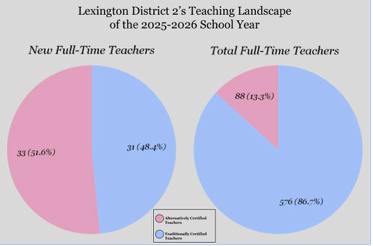
According to Rabon, 33 out of the 64 incoming teachers in Lexington District Two for the 2025-2026 school year are on alternative certification tracks. He added that at the start of the 2025 school year, staffing shortages were not an issue the district faced.
There are 18 approved alternative pathways in South Carolina that include statewide and national programs. The full list of alternative pathways can be found on the South Carolina Department of Education website.
One of the major alternative programs that works with Lexington District Two is the Carolina CAP (Carolina Collaborative for Alternative Preparation). This approved alternative certification program is based at the University of South Carolina and partners with 42 districts across the state.
“We work with our districts to meet their recruitment needs. We support their candidates. We also have a residency component in some districts, with resident site-based coaches. We all work together to provide a rigorous personalized pathway for candidates,” said program director Dr. Tria Grant.
Grant said Carolina CAP, like most alternative pathways, requires participants to teach in the classroom while also taking courses. The courses focus on proper teaching theory and practices and are taught mostly by USC professors. The program is funded primarily through state legislation.
Program participants found the certification process beneficial.
“I was a stay-at-home mom for 10 years. But within those 10 years, I was working on my bachelor's in liberal studies. But I've always wanted to do something with education, and the Carolina CAP has helped me transition from liberal studies to education,” said Mary Kammes, a Carolina CAP participant who teaches at Lexington Two’s Riverbank Elementary.
Kammes said teaching and taking classes can be a big adjustment, but “it's very rewarding.”
“Being able to have hands-on experience while also getting certified, I thought that was the perfect fit for me,” Kammes said. “I enjoy working with little kids and just how excited they get to learn something new, and I am part of that in their learning journey.”
For more information
Find details about Lexington Two's alternative certification pathways under the DEPARTMENTS/HUMAN RESOURCES menu item on the district website.
This story was submitted by Calvin Landreth. He is a broadcast journalism student at the University of South Carolina Honors College. He enjoys writing short stories and learning new things. Contact him at calvinrl@email.sc.edu